




Text-to-image AI tools have rapidly evolved into essential resources for designers, marketers, and content creators. These platforms allow users to transform simple text prompts into highly detailed visuals, reducing the need for traditional design workflows. As competition grows, the differences between tools now lie in output quality, customization, speed, and usability.
This guide explores five of the best tools available today, focusing on real-world usability rather than hype. Each platform offers a distinct approach to AI image generation, making them suitable for different types of users—from beginners experimenting with prompts to professionals building visual assets at scale.
1. Pollo AI (Best for Overall Balance and Multi-Model Flexibility)
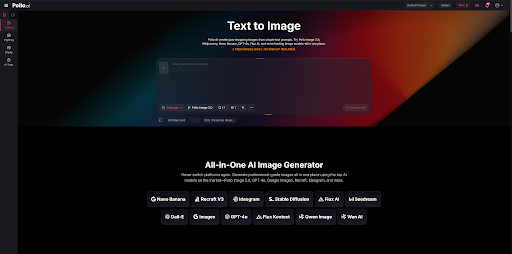
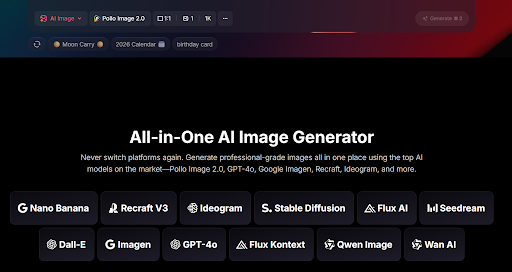
Pollo AI text to image stands out as a well-rounded that combines multiple AI generation capabilities into a single interface. It supports not only text-to-image workflows but also image-to-image transformations and even video-related features, making it a versatile choice for users who want more than just static visuals. The platform integrates several underlying models, allowing users to experiment with different styles without switching tools.
From a usability perspective, Pollo AI is designed to accommodate both beginners and advanced users. The interface remains accessible while still offering deeper controls for prompt refinement and output adjustments. This balance makes it particularly suitable for creators who want consistent results without spending excessive time learning complex systems.
Key Strengths
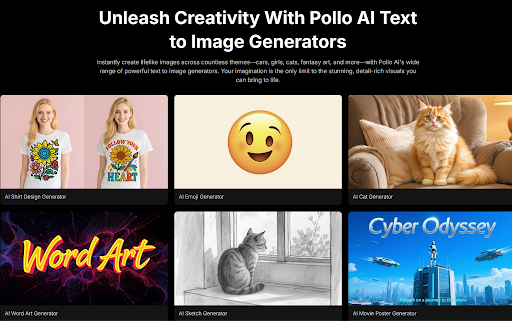
Another notable advantage is the consistency of output quality. Generated images tend to maintain coherent lighting, composition, and detail, even with more complex prompts. This reliability is useful for users working on branding, storytelling, or content production where visual consistency matters.
Additionally, those exploring text to image AI workflows with Pollo AI will find that the platform handles prompt interpretation effectively. It produces results that align closely with user intent, reducing the need for repeated iterations. This makes it a practical option for both rapid prototyping and polished final outputs.
2. MidJourney (Best for Artistic and Stylized Image Creation)
MidJourney has built a strong reputation for producing visually striking and highly stylized images. Unlike some tools that prioritize realism, MidJourney leans toward artistic interpretation, often generating outputs that resemble digital paintings or concept art. This makes it especially popular among illustrators and creative professionals.
The platform operates primarily through a chat-based interface, which may feel unconventional at first. However, once users become familiar with its prompt structure, it offers a high degree of creative control. The community-driven aspect also provides inspiration, as users can explore and refine prompts based on shared results.
Key Strengths
One of MidJourney’s biggest strengths is its ability to generate unique and expressive visuals. Even simple prompts can yield complex and aesthetically rich images, which is ideal for concept design and storytelling. The tool also handles textures and lighting exceptionally well.
However, it may require more experimentation compared to other platforms. Users looking for precise control or predictable outputs might need additional iterations. Despite this, it remains a strong option for those prioritizing creativity over strict realism.
3. DALL·E (Best for Accurate Prompt Interpretation and Ease of Use)
DALL·E is known for its ability to accurately interpret natural language prompts and translate them into coherent images. It is particularly effective at handling detailed instructions, including object placement, style references, and contextual elements. This makes it a reliable choice for users who need specific visual outcomes.
The platform is also integrated into various applications, making it accessible across different workflows. Its ease of use allows beginners to quickly generate images without needing advanced prompt engineering skills.
Key Strengths
A major advantage of DALL·E is its precision. It tends to follow instructions more closely than many competitors, which is valuable for tasks such as marketing visuals or educational content. The tool also performs well when combining multiple concepts into a single image.
For those experimenting with AI image generation through this platform, the learning curve is relatively low. Users can achieve solid results quickly, making it a practical option for both casual and professional use cases.
4. Seedance 2.0 (Best for Advanced Control and Emerging AI Capabilities)
Seedance 2.0 represents a newer generation of AI image tools that focus on providing enhanced control over outputs while maintaining modern model performance. It is designed for users who want to explore more advanced prompt structures and experiment with evolving AI capabilities without fully diving into complex open-source setups.
The platform aims to bridge the gap between accessibility and customization. While it does not require the same level of technical expertise as traditional open-source frameworks, it still offers enough flexibility for users who want more influence over style, composition, and generation parameters.

Key Strengths
One of the main strengths of Seedance 2.0 is its balance between control and usability. Users can fine-tune outputs more precisely compared to many beginner-focused tools, making it suitable for semi-professional workflows.
At the same time, those exploring flexible text to image AI solutions in this space will appreciate its ability to adapt to different creative needs. Whether generating concept visuals or refining stylistic outputs, it provides a middle ground between simplicity and depth.
5. Leonardo AI (Best for Game Assets and Consistent Design Workflows)
Leonardo AI is designed with creators in mind, particularly those working on game development and digital assets. It provides tools for generating consistent character designs, environments, and textures, making it well-suited for production workflows.
The platform emphasizes organization and asset management, allowing users to maintain consistency across multiple generations. This is especially useful for teams or individuals working on long-term projects.
Key Strengths
One of Leonardo AI’s standout features is its focus on consistency. Users can generate variations of the same concept while maintaining a unified style, which is essential for game design and branding.
In addition, those exploring creative AI image tools for design projects will find that Leonardo AI supports iterative workflows effectively. It allows users to refine and expand ideas without starting from scratch each time, improving efficiency and output quality.
Final Thoughts
The landscape of text-to-image AI tools continues to evolve, with each platform offering unique strengths. Pollo AI provides a balanced and versatile experience, while MidJourney excels in artistic expression. DALL·E focuses on accuracy, Seedance 2.0 offers flexible control, and Leonardo AI supports structured creative workflows.
Choosing the right tool ultimately depends on individual needs. Users seeking simplicity and reliability may prefer integrated platforms, while those looking for flexibility might lean toward tools that allow deeper customization. As AI technology advances, these platforms are expected to become even more capable, further transforming how visual content is created.