




We already know it: this beautiful country boasts a vast number of tabletop games enjoyed by both adults and children alike, ready to be played during family nights or warm holiday periods like Christmas. Slotornado offers many card games to suit every taste.
Some of them hold a special place in the hearts of many players, and that is exactly the case with Donkey (known in Italy as Asino), a typical card game of the Italian tradition characterized by simple rules, short sessions, and a great deal of fun!
The combination of luck, speed, and focus makes this flawless classic suitable for practically all types of players. That is why we are going to talk about its rules, the mechanics that compose it, and—why not—understand if it is possible to use strategies capable of increasing our chances of winning.
Donkey: A Card Game Shrouded in Mystery
If you have already discovered the origins of some classics of our tradition, such as Horse Racing, you know that many of them lack documents or other sources capable of shedding light on their beginnings. The protagonist of this article also belongs to this circle: Donkey, a card game that continues to fascinate us, is shrouded in mystery even today.
According to some sources, Donkey originated as a simple folk pastime in 19th-century Italy, passed down orally over time within families or schools (likely giving life to numerous local variations along the way).
What is certain is that the name “Donkey” comes from the term used to designate the loser of the game (in a joking tone, of course). It is also known by names such as Zonzo, Fool, or Jackass, which effectively convey the weight of defeat.
In some variants, the losing player is forced to undergo a small penalty, such as receiving a letter from the word “DONKEY” written on their hand or forehead.
All of this leads one to think that the card game Donkey is intended primarily for a younger audience, which we can confirm without issue. However, its characteristics do not prevent adults from having fun during a pleasant day in the company of friends and family!
How the Card Game Donkey Works
Having briefly discussed its history, let’s look at the rules of the card game Donkey.
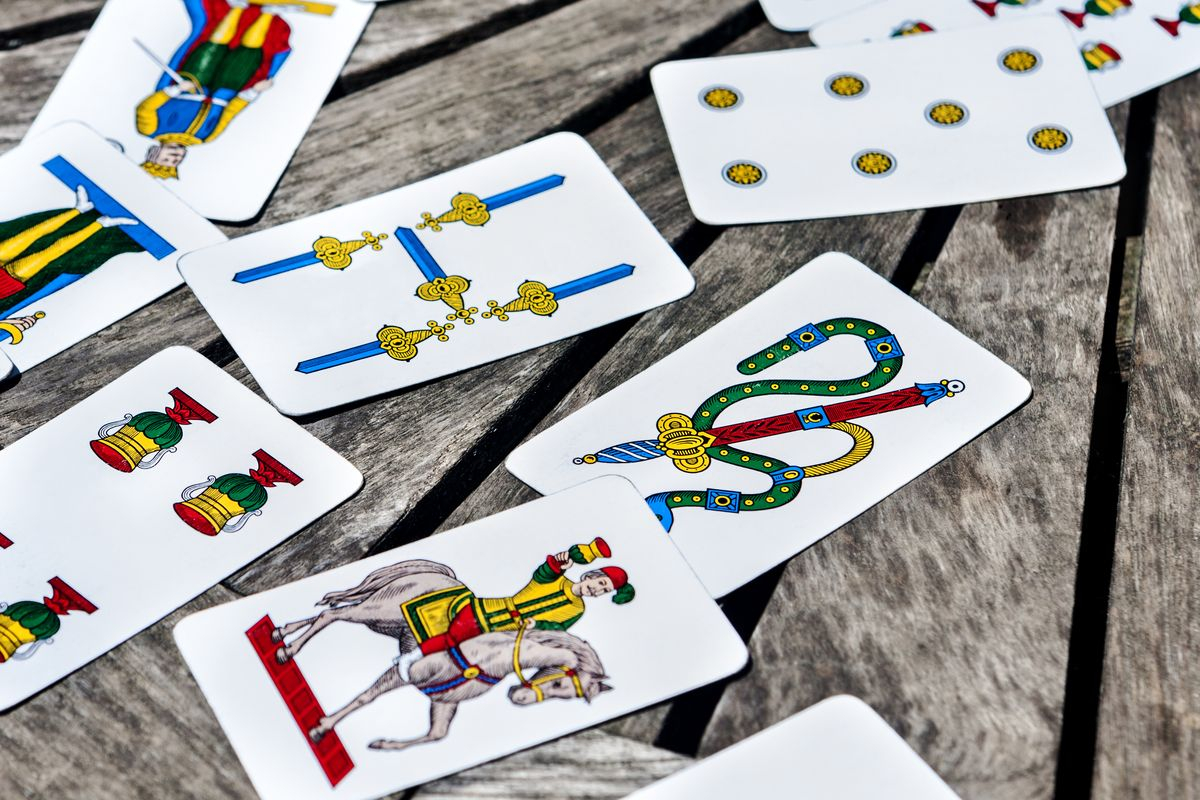
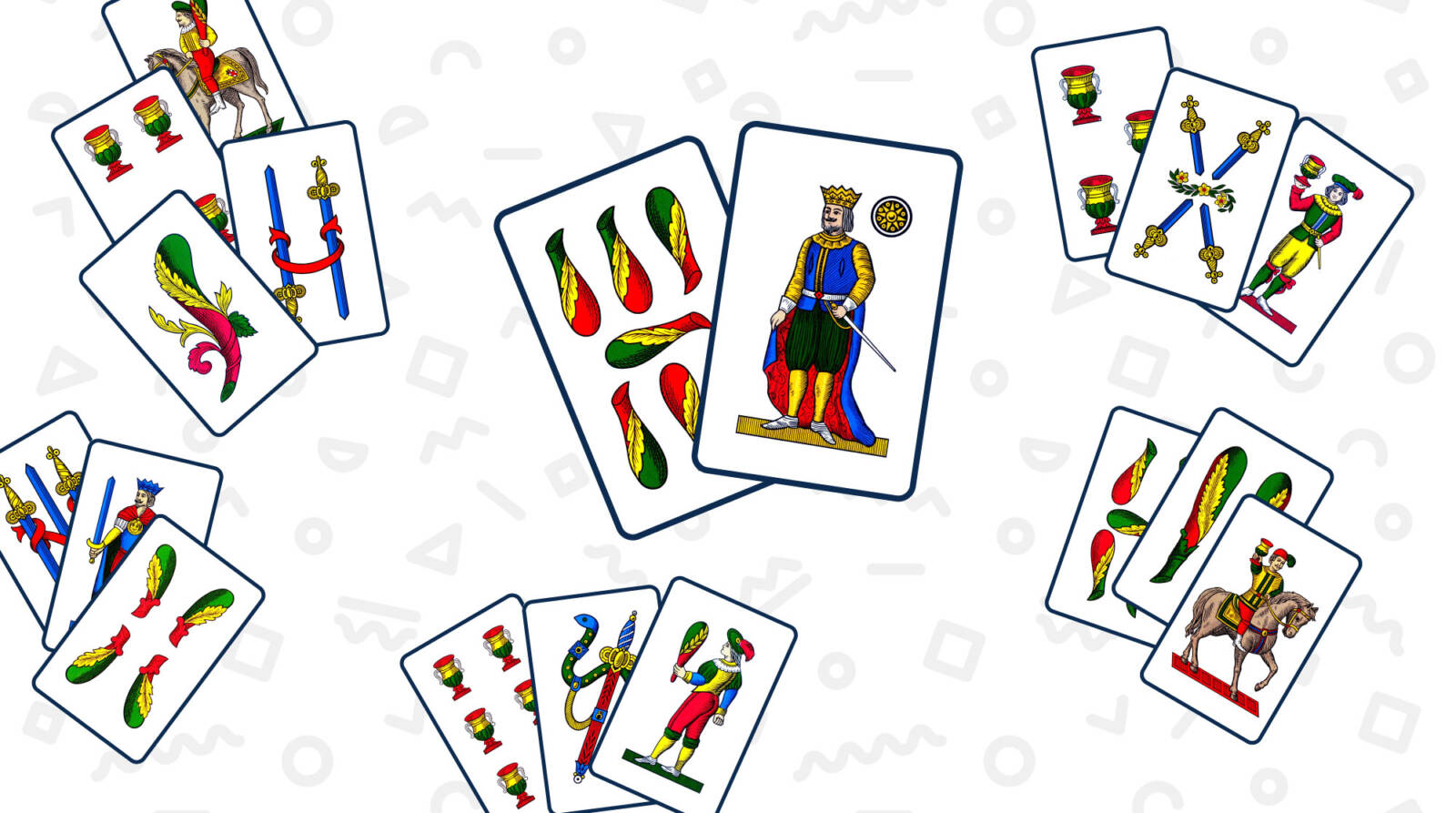
The game requires a deck of 40 regional cards (a French deck can be used by making adjustments) and a number of players ranging from two to eight participants.
Our main goal is to avoid being the last player left with a single card that cannot form a pair.
First and foremost, a dealer must be chosen to manage the game. This can be done based on your preference, but a classic draw for the high card is always best.
The dealer draws one card, which neither they nor the other players can see, and sets it aside. Then, they begin to deal the entire deck counter-clockwise, officially starting the session.
During the first stage, you must discard all pairs present in your hand. Afterward, players take turns choosing a random card directly from the hand of the player sitting to their right, always with the aim of forming a pair to be permanently discarded.
At this point, you realize that the loser of the game will be the player left holding the card whose “sister” was removed at the start of the game.
Example of Play
To make the experience even clearer, let’s provide an example of a game session involving three participants.
Stage 1: The dealer is selected via a draw system, then a random card is removed from the deck, and the full distribution of cards begins.
Stage 2: Like the others, you received thirteen cards. Your hand consists of 2 Kings, 2 Aces, 2 Queens, 2 Threes, 2 Fives, 1 Knight, 1 Seven, and 1 Two. You remove all pairs, leaving you with a hand consisting of the last three cards.
Now the real rounds begin:
Round 1
We are to the right of the dealer, so it is our turn to make the first move, and we choose a random card from the hand of the player sitting to our right. We receive a 7 and discard that pair as well. Naturally, someone also takes a card from us, leaving us with 1 Knight and 1 Two.
Round 2
We take a card from our opponent and receive a King. Having no other matching cards, we must keep it in our hand. The player to our left takes it, leaving us again with 1 Knight and 1 Two. Then, we take a card from the hand of the player to our right and get a Two, leaving us with only the Knight.

Round 3
We draw a matching Knight and finally emerge as a winner, while the other two players compete. The player to our left has a hand with 1 King and 1 Six; the player to our right has 1 Six. The latter takes the opponent’s Six and leaves them with 1 King, making it clear that the card removed at the start of the game was the final King.
Donkey Strategies: Cards and Cunning
One reason we adore games like the very popular Briscola and Scopa is that luck is not the only element determining the outcome: intelligence and skill can overturn a desperate situation and lead to victory.
However, regarding the game of Donkey, cards and luck practically go hand in hand, which often makes the use of logical systems futile.
So, what is the ideal solution to outperform our opponents? The answer is very simple: deception.
Arrange your cards in such a way that one card looks more “attractive” to be drawn by the player to your left, shuffle everything after each draw, bluff, and hide your emotions while closely observing the emotions of other players.
A truly winning system may still prove to be memory: if we find four different Kings in our hand during various rounds, we are certainly not dealing with the “unlucky” unpaired card.
For players who enjoy the competitive edge that card games like Donkey develop, online casino card games offer a natural next step. Platforms now host everything from classic table games to fast-paced variants, and the experience has improved dramatically in recent years. For Canadian players especially, one of the most practical considerations when choosing a platform is how quickly winnings are processed — finding the fastest withdrawal online casino Canada has available means less waiting and more playing. It’s a detail that matters more than most newcomers expect, and one that separates a frustrating experience from a genuinely enjoyable one.
Questions and Answers about the Card Game Donkey
How do you play the card game Donkey?
You must eliminate all pairs from your hand, avoiding being the only player left with a single card in hand at the end of the game.
How many players are needed to play Donkey?
The minimum number of players is two, while the maximum is eight.
Are there other games similar to the card game Donkey?
There are some similar card games, such as Peppa or Old Maid, as well as board games like Uno that use practically identical dynamics.
Are there variants of the card game Donkey?
You may encounter some regional variants, such as Spazzino, or versions modified by the players themselves.