


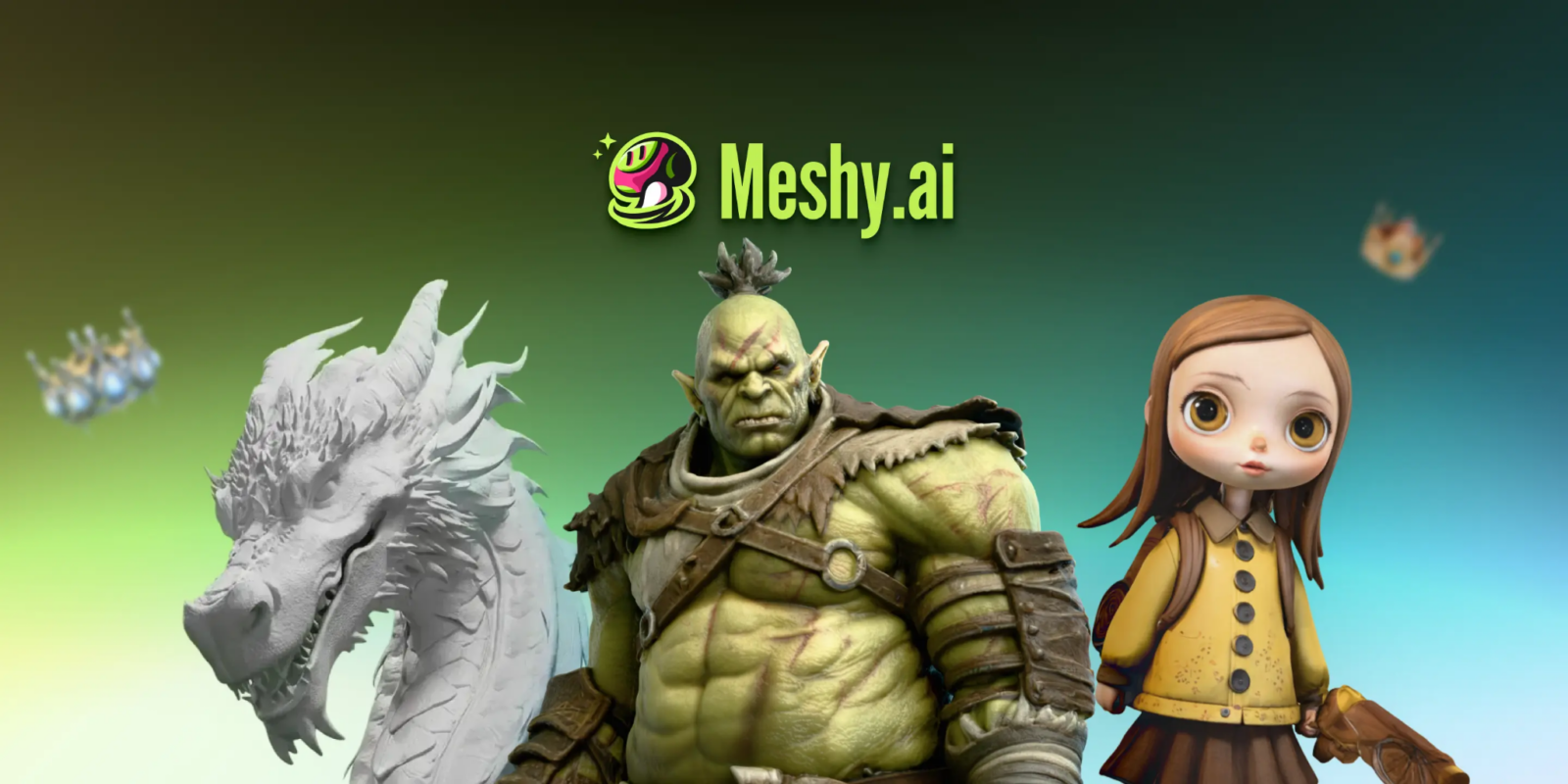

Meshy AI turns text or images into textured 3D assets in about 30 seconds. It also hosts more than 580,000 free 3D models in FBX, OBJ, GLB, and STL. For game developers, the practical gain is throughput rather than artistry. You get props and blockouts on demand, including the ones no catalog happens to stock.
Where Do Free 3D Models Fall Short for Games?
Sketchfab, CGTrader, TurboSquid, and Free3D all work well when the asset you need already sits in the catalog. The gap opens when it does not, which happens more often than the rankings for this search suggest.
Free3D itself notes that only a handful of its models are built for real-time. That is a fair indicator of how much cleanup the rest need.
Three problems show up repeatedly in production:
- The specific prop your level needs does not exist, so you either compromise the design or model it yourself.
- Licensing is set per model, so commercial clearance turns into a per-file audit.
- Polycounts are rarely tuned to engine budgets, so import usually means retopology work.
A library still handles most of an asset list. The useful comparison is how each option deals with the leftovers.
What Does Meshy AI Actually Do for Game Assets?
Meshy AI is a hosted platform covering text-to-3D, image-to-3D, and automatic PBR texturing. Meshy-6 reached general availability on 18 January 2026 with cleaner hard-surface geometry and a low-poly mode.
The company raised nearly $400 million at a $1.5 billion valuation in July 2026, per PR Newswire. Its named game customers include Nexon, NetEase Games, and 37 Interactive Entertainment, per 3Dnatives.
How Does Meshy 3D Agent Support Game Asset Iteration?
Meshy launched its 3D Agent on 4 June 2026, billed as the first AI agent for 3D creation. It chains steps: brainstorm, batch variations, and then generate mesh and textures.
Where plain text-to-3D returns one output per prompt, the agent keeps a loop running across those steps. It does not support direct 3D editing yet, so treat it as a concepting tool.
Free Tier Limits Worth Knowing First
The free plan gives 100 credits per month and 10 Meshy-5 downloads. Meshy-6 models generate on the free tier but cannot be downloaded.
Free outputs carry a CC BY 4.0 license, so you can ship them commercially as long as you attribute Meshy. Paid tiers drop that requirement.
Is Generative AI Replacing Game Art Teams?
Not according to the people doing the work, who report the least enthusiasm of any group surveyed.
GDC’s State of the Game Industry 2026 surveyed more than 2,300 professionals. Of those, 52% consider generative AI’s impact negative, up from 30% in 2025 and 18% in 2024. Visual and technical artists were the most unfavorable group at 64%, and positive sentiment across the sample fell from 13% to 7%.
Only 30% of studios reported using generative AI, against 58% at publishing, support, and marketing firms.
Ethan Hu, Meshy’s CEO, has described the same split. Studios use AI for props like chairs, tables, and rocks, while hero characters stay rare because the quality bar is higher.
So the realistic claim is narrower than a 10x pipeline. Generation compresses the dull half of an asset list, while rigging, LODs, and art direction consistency take about as long as they always did.
How Do You Get A Generated Mesh Game Ready?
Budget 30 to 45 minutes of cleanup per asset in Blender. That figure comes from practitioner workflow guides rather than from tool reviews, which tend to stop at generation time.
Set your polycount target before export rather than fixing it afterward. Meshy publishes targets of roughly 50,000 triangles for a hero character, 10,000 for an NPC, and 3,000 for a prop.
Five Steps Before Engine Import
Order matters here, because decimating before you fix normals bakes the errors in.
- Merge by distance and delete interior faces.
- Run Select, then Non-manifold, and fix what it finds.
- Recalculate normals, then decimate or retopologize to your budget.
- Apply scale with Ctrl+A so Unity or Unreal imports at 1:1.
- Bake a normal map from the dense mesh onto the clean one.
Failure Modes You Will Hit
Most of these surface within a minute of import:
- Distorted faces and extra fingers on characters, a recurring complaint in Meshy’s user community.
- Non-manifold geometry that engines reject, which was common before Meshy-6 tightened watertightness.
- Scale mismatch on import, landing models at 100x because units are not encoded.
- Auto-rig spines that break on unusual proportions.
- Baked lighting in the texture that fights the lighting in your scene.
Do You Have to Disclose AI Assets on Steam?
Yes, if the AI content ships in the game. Valve added an AI disclosure to its Content Survey on 10 January 2024. It rewrote the rules on 17 January 2026 to focus on player-facing content, exempting coding assistants.
GameDiscoverCo’s Simon Carless, cited by PC Gamer in July 2026, puts AI disclosure at 30.8% of Steam launches so far this year. It was 19.9% in 2025 and 10.9% in 2024.
Not everyone thinks the labels help. Epic CEO Tim Sweeney argued in November 2025 that AI labels “make no sense,” given how embedded the tooling already is.
itch.io went further in November 2024, requiring AI tags and de-indexing listings that skip them. The tag is worth adding even where it is optional.
Can You Copyright A Game Built On AI Meshes?
Partly, and only if you do real work on the output. The US Copyright Office published Part 2 of its copyrightability report on 29 January 2025. Purely AI-generated works are not protected, and prompting alone does not create authorship.
Protection extends to your selection and arrangement of AI material, and to any human modification you make on top of it.
Retopologizing a mesh improves quality, and it also builds the record of human authorship that any claim depends on. None of this is legal advice, and your jurisdiction may differ.
Key Takeaways
- Meshy AI works best on props, blockouts, and iteration speed, not on shippable hero characters.
- Budget 30 to 45 minutes of cleanup per asset before engine import.
- Free-tier outputs use CC BY 4.0, so commercial use requires attributing Meshy.
FAQs:
Are Meshy’s free 3D models really free for commercial use?
Yes, with a condition. Free-tier outputs are licensed CC BY 4.0, so commercial use requires crediting Meshy. Paid plans grant full ownership without attribution. The library exports in FBX, OBJ, GLB, and STL.
Is Meshy better than Tripo or Hunyuan3D?
That depends on your constraints. Meshy’s comparison claims come from an internal study with 11 evaluators, so treat them as marketing. Tencent’s Hunyuan3D 2.1, released in June 2025, is fully open-weight, which matters if you need local generation.
How long does a Meshy generation take?
Roughly 20 to 30 seconds for the mesh and about a minute for texturing. Cleanup is the slower half at 30 to 45 minutes per asset in Blender.
What is the Meshy 3D Agent?
Launched 4 June 2026, it is a conversational agent that chains brainstorming, concept batching, modeling, and texturing. Unlike single-prompt text-to-3D, it iterates across those steps. It does not support direct mesh editing, so it works alongside Blender rather than replacing it.
Where Meshy Fits In An Asset Pipeline
Meshy earns its place at the props and greybox end of the list. It beats searching free 3D model libraries when the asset you need was never made, and it can compress a two-day blockout into an afternoon. What it will not produce is a shippable hero character, which is the one point where the GDC 2026 data and Meshy’s own CEO agree. Generate the rocks and crates, and keep your artist on whatever the player looks at twice.