

Price movements create lots of opportunities in forex, crypto, and many other financial markets. While some trading strategies attempt to figure out where the price might go next, others focus on systematically responding to price movement itself.
Grid trading falls into the latter category. It does not try to forecast market direction. Instead, it attempts to profit from repeated price fluctuations within a predefined price range. When used carefully, often with automation, it can successfully turn sideways prince movements into profits.
Let’s explain how grid trading works, when it performs best, where it usually fails, and how traders automate the system to remove emotions from grid trading.
How Grid Trading Works Mechanically
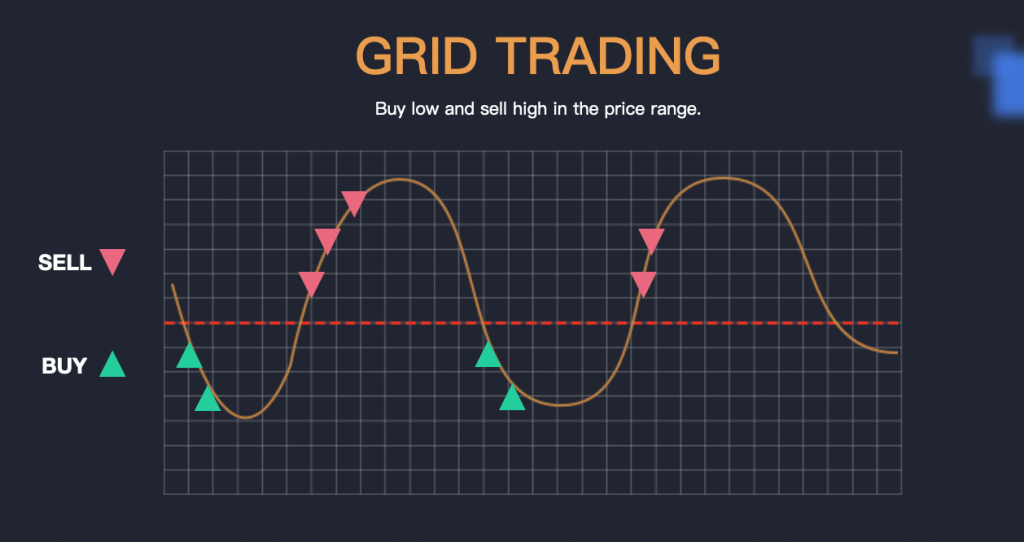
To understand what is grid trading and how does it work, it helps to picture a price chart divided into evenly spaced levels, like a grid over the market. A grid strategy places multiple buy and sell orders at predetermined price intervals, above and below the current market price. Each level represents a potential trade entry or exit.
Here is a list of practical steps:
- Define a price range
Firstly, the trader selects an upper and lower boundary for the market they are going to trade. This is the first step and a very crucial one, because a well-defined range can make a difference between profits and losses.
- Divide the range into intervals
The range is split into evenly spaced levels, which are your grid lines. Traders might use deviations or Average True Range to define the distance between lines. Lines based on average price swings will work best in most of the cases.
- Place buy and sell orders
- Buy pending orders are placed at lower grid levels
- Sell pending orders are placed at higher grid levels.
This is to ensure we buy cheap and sell expensive.
- Profit from price fluctuations
When the price drops to a buy level, the pending order becomes a market order, and the trade executes. If the market later goes up to the next grid level, the corresponding sell order will capture profit.
The strategy repeats this process several times each day, across multiple price levels. Every movement between grid lines creates a potential trade opportunity.
Buy/sell orders at intervals – A simple example
Imagine a trader sees that the stock price usually fluctuates between $90 and $100 for days. They can divide this range into several intervals, including $90, $95, $100, $105, and $110. The trader will place buy orders at lower levels and sell orders at higher ones. In other words, buy orders should be below the current price and sell orders above it. If the price falls from $100 to $95, a buy order will trigger, and if it later rises back to $100, the sell order locks in profits. Over time, many small trades can accumulate considerable profits. Unlike strategies that try to gauge the market direction, grid trading does not rely on predicting anything. Instead, it just attempts to profit from normal price behavior itself.
When Grid Trading Performs Well
Grid trading is a powerful approach to trading, but it does not work in all markets. Knowing this is critical to ensure your chances of profits are high. The most suitable market regime is the sideways market. When prices move sideways for extended periods, they create perfect conditions for grid trading systems to succeed.
Frequent Price Reversals
The strategy is especially profitable when the price tends to reverse often. These conditions are usually described as ranging markets, where the price repeatedly bounces between support and resistance levels without forming a distinctive trend. In range-bound markets, prices create many opportunities for grid trading systems. Each reversal can trigger a buy or sell order in the grid. This creates a healthy sequence of trades.
Since the strategy is based on predetermined price levels rather than predictions, traders do not need to constantly guess where the market might go next. The grid structure simply reacts to the environment.
Volatility Without Direction
Some instruments can experience high volatility while remaining within a broad range. This behavior is common in forex and crypto markets and can produce many opportunities for grid systems. Instead of viewing the volatility as a risk, grid traders treat it as a source of repeated trading opportunities.
When Grid Trading Performs Poorly
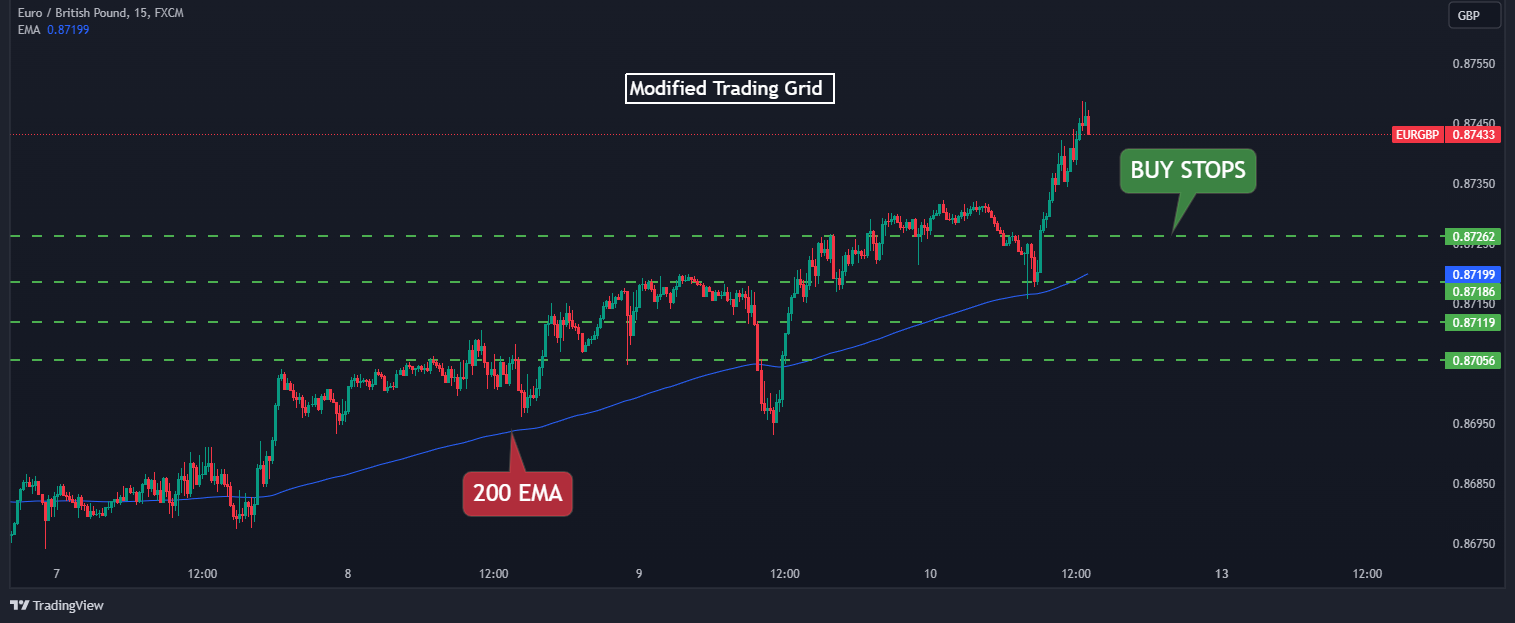
Despite being so attractive and useful in many scenarios, grid trading has a major weakness: strong trends. When markets begin consistently moving in one direction, the grid strategy will break down and start to lose lots of money.
Strong trends
If an asset suddenly rallies, the strategy can continue placing buy orders at lower levels while missing the larger upward move in the process. On the other hand, if the price crashes downward, the system will accumulate losing positions as it repeatedly buys at falling levels. What you are left with is a series of losing trades that continue to accumulate losses. This phenomenon is also called a grid drift. If the trader misses this moment, they can even evaporate the whole trading account.
Capital requirements
Grid often requires a sufficient amount of money to support multiple open positions. Traders need to implement strict risk controls to prevent runaway losses, and this can only be achieved by having clear rules for stopping the system if the market leaves your predetermined range.

Automation Options and Tools
Running a grid trading strategy manually is very difficult. Multiple price levels, constant monitoring, and quick order execution make automation very useful. For this reason, grid trading is usually associated with algorithmic or automated trading systems. There are several ways to automate the system.
Trading bots (Expert Advisors)
Trading bots are the most popular tools for implementing grid systems successfully. These programs automate the whole process of trading from placing orders to executing trades, and they can even adjust orders as positions open and close multiple times.
Many crypto exchanges now offer built-in grid trading bots as part of their trading interface. This is because grid trading is especially popular among crypto traders.
Algorithmic Trading Platforms
More advanced traders might employ algorithmic trading platforms that allow them to design custom grid systems. These tools enable users to define grid parameters, integrate risk management rules, and backtest strategies using historical data. Backtesting helps traders see how a grid strategy would have performed on historical price data.
Risk Controls and Monitoring
Even with automation, grid trading requires strong safeguards. Common controls include stop-loss thresholds to exit markets when strong trends appear. Another one is to dynamically adjust the grid if volatility changes and price swings become larger. Finally, capital allocation limits are a must to prevent excessive risk-taking.
Why the Strategy Remains Popular
Despite its many limitations, grid trading continues to attract both retail and algorithmic traders. There are several good reasons why this is the case.
First, the strategy is heavily mechanical and transparent, meaning traders know exactly where orders will be placed and how they will be executed.
Second, grid trading strategies successfully capitalize on volatility without predicting anything, which is a major advantage, especially in unpredictable or uncertain market regimes.
Third, modern automation tools are advanced and enable grid traders to automate the whole process with strong risk controls and customization options. The fact that even crypto exchanges started to offer built-in grid automation tools indicates how popular and potent this strategy can be.