




It’s 2pm. You’ve been staring at spreadsheets for three hours. Your eyes hurt. Your thoughts feel like they’re moving through mud.
So you grab coffee. Check Instagram. Maybe watch a few TikToks.
Twenty minutes later you feel worse.
Here’s what most people get wrong about breaks. Scrolling isn’t rest. Your brain stays in consumption mode, processing endless streams of new information without ever getting a chance to reset.
Research on sustained attention shows that after 50 to 90 minutes of focused work, your cognitive resources start depleting. Performance drops. Errors increase. The prefrontal cortex begins running on fumes.
What your brain actually needs isn’t more stimulation. It needs structured disengagement. A defined task with clear boundaries. Something that shifts your mental gears without adding to the noise.
Why Solitaire Beats Doomscrolling
Social media has no endpoint. You can scroll forever. The algorithm is designed to keep you hooked, not to let you go.
Solitaire works differently.
A game has a beginning. A middle. An end. When you finish a hand, your brain gets that satisfying click of completion. Same feeling you get checking something off your to-do list.
That sense of closure triggers a small dopamine release. Not the artificial spike from viral content, but a gentler reward signal that tells your brain “task complete.”
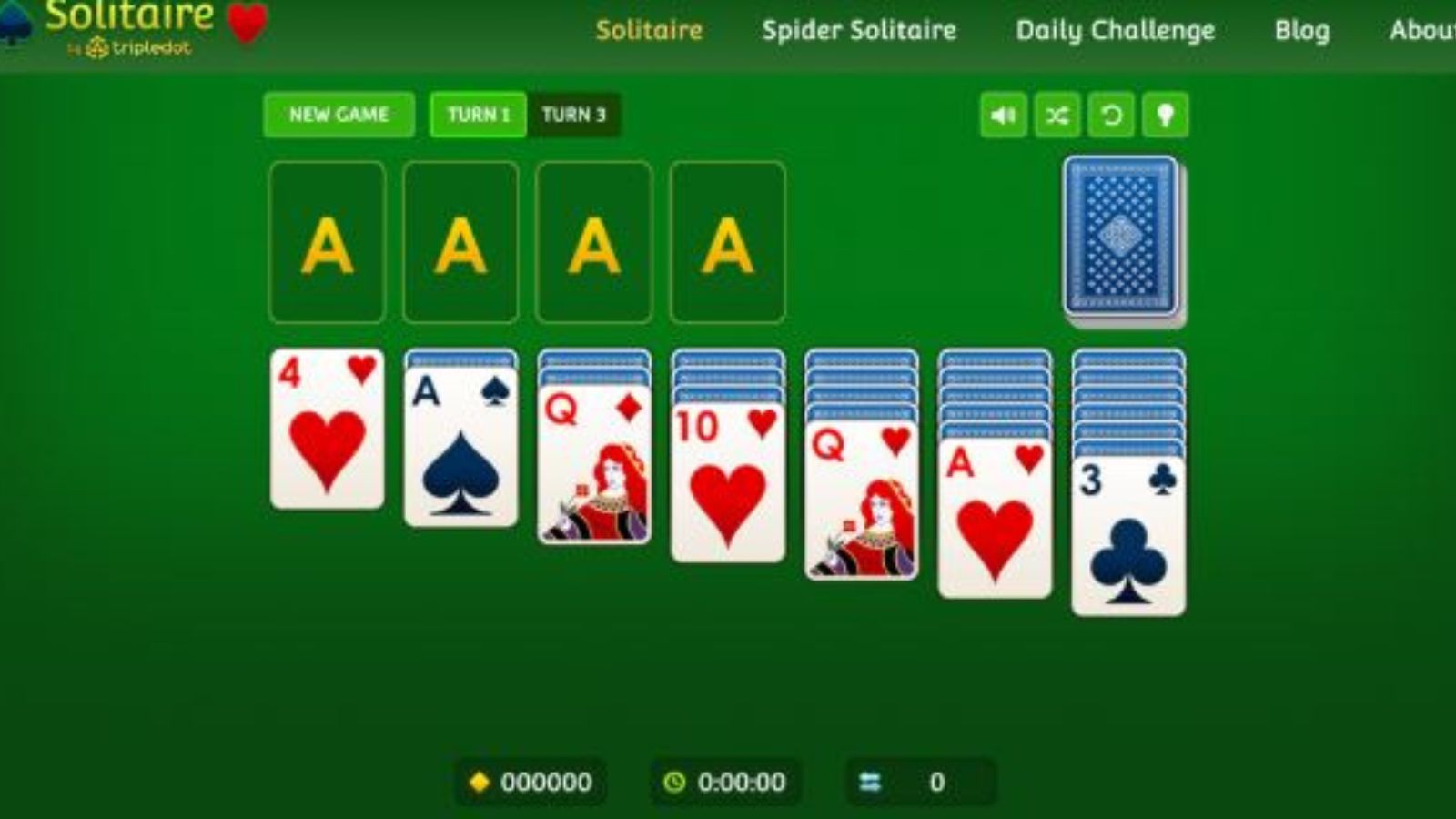
There’s also the engagement sweet spot. Solitaire requires just enough attention to pull your mind away from work stress. You’re not wrestling with quarterly projections. You’re thinking about which card goes where, whether to move that seven of hearts now or wait for a better opening.
But it’s not so demanding that it tires you out. The rules are simple. The stakes are zero. Win or lose, nothing bad happens. You just shuffle and start again.
This is why office workers have been sneaking games of solitaire on their computers since Windows 3.0. They intuitively understood something science later confirmed.
The Science Behind Why Solitaire Relaxes Your Brain
When you play solitaire, something interesting happens in your brain. The regions grinding on work problems finally get to quiet down.
Your prefrontal cortex takes a back seat. Meanwhile, other areas light up. Visual processing kicks in as you scan the tableau. Working memory engages as you track which cards you’ve seen and which might be buried in the stockpile.
It’s like giving one muscle group a rest while exercising another. Athletes call this active recovery. Your brain benefits from the same principle.
The University of Wisconsin-Madison studied people who regularly played games and completed puzzles. Results showed they performed better on memory tests and displayed increased cerebral volume compared to non-players.
Solitaire specifically hits a cognitive sweet spot. Pattern recognition. Sequential thinking. Spatial reasoning. These tasks feel almost meditative once you get into rhythm. You enter a flow state where work anxieties fade into the background.
Neuroscientists have found that brief mental diversions improve focus when you return to challenging work. Ten minutes of solitaire works. Ninety minutes of gaming does not.
Building A Sustainable Solitaire Break Habit
Most people hit their first wall around 10 or 11am, then again after lunch, and once more around 3pm.
Watch for the warning signs. Rereading the same paragraph three times. Making careless typos. Feeling irritable for no clear reason.
When you notice them, that’s your cue. Open up a game.
Keep your break short. One or two games of Klondike takes about ten minutes. That’s plenty. Longer than that and you’ll have trouble getting back into work mode.
Some practical tips:

● Don’t check your phone during the game
● Close your email tab
● Set a two-game limit and stick to it
Solitaire requires nothing special. No equipment beyond a browser or a deck of cards. No special room. You can play at your desk, on your couch during lunch, or anywhere with a few minutes of quiet.
The accessibility matters. The best habit is the one you actually do.

Measuring Your Mental Clarity Improvement
After two or three weeks of regular solitaire breaks, pay attention to the changes.
Notice your afternoon meetings. Are you following conversations better? Contributing more useful ideas? Feeling less drained afterward?
Check your work output. Fewer errors on detailed tasks signals improved focus. Complex problems that stumped you before lunch might yield to fresh thinking after a quick game.
Your mood tells a story too. Less irritability. More patience with difficult colleagues. Finishing the day with fuel still in the tank.
Here’s something interesting from recent research. A study of over 4,000 people found that how someone plays solitaire can predict certain cognitive abilities. The patterns in gameplay reflect processing speed, attention, and memory function.
Experiment with timing. Some people do better with a morning game to warm up their brain. Others need that post-lunch reset more. Find what works for your schedule.
The goal isn’t becoming a solitaire champion. It’s giving your brain what it actually needs to function well all day long.