




Every team that scales a data operation eventually hits the same wall. The proxies work in a demo, pass a quick test, and then quietly fall apart in production. IPs get flagged within hours, success rates start sagging, and nobody can say exactly why. More often than not, the real problem isn’t the code or the target site. It’s that the proxy pool was never what it claimed to be in the first place—recycled datacenter ranges dressed up as residential, or IPs pulled from sources the vendor would rather not explain.
In a market this crowded, the useful question isn’t “how fast” or “how cheap.” It’s “can I actually verify what I’m buying?” Speed and price are easy to advertise and hard to trust. Sourcing and transparency are harder to fake. That’s why the search for a trusted proxy provider increasingly starts with where the IPs come from, not with the headline numbers on the pricing page. What follows is a practical framework for sizing up a residential IP network before you commit any budget, using IPcook as a reference point for what each criterion looks like in the real world.
Where the IPs Come From: The First Question, Not the Last
Sourcing is the thing most buyers check last, and it should be first. A residential proxy is only worth anything because the IP belongs to a real household connection—the same kind of network an ordinary visitor uses—which is exactly what makes it hard for a target site to tell apart from normal traffic. The moment a pool gets quietly padded with datacenter IPs, or built through methods the vendor can’t describe, you’ve inherited two problems at once: a higher chance of getting blocked, and a legal gray area you didn’t sign up for.
A network you can’t audit is a liability, not an asset.
IPcook is straightforward on this point: its pool is ethically sourced and residential, drawn from genuine household connections rather than datacenter blocks. That’s not decoration. It’s the difference between IPs that keep working over months and IPs that stop working the day a site tightens its filters. So when you evaluate any provider, just ask how the network is built. A clear answer is a good sign. A vague one tells you everything you need to know.
Scale Without Blind Spots: Reading Pool Size Honestly
A big number is easy to print. What actually matters is whether that scale sits where you operate. A pool of tens of millions of IPs does you no good for German price monitoring if barely any of them are in Germany.
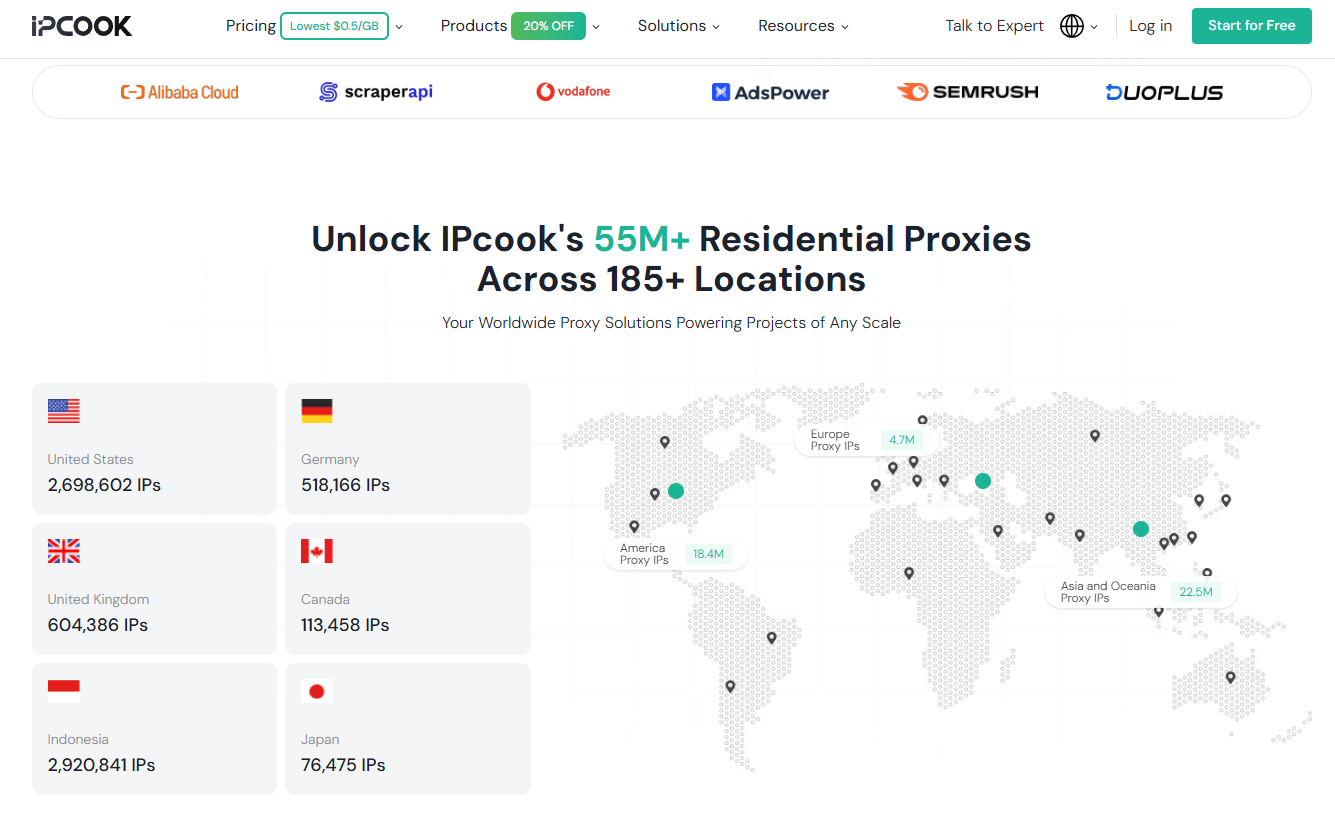
IPcook reports more than 55 million residential IPs across 185+ countries, and—more usefully—it publishes the regional breakdown: roughly 18.4 million across the Americas, 4.7 million in Europe, and 22.5 million across Asia and Oceania. That kind of transparency lets you check coverage against your own targets before you pay, instead of finding the gaps halfway through a project. A larger, well-spread pool also means lower reuse, so you’re less likely to be handed an IP a site has already seen and flagged.
Flexibility as a Trust Signal: Rotation, Sessions, and Protocols
A service that forces the same behavior on every task is telling you it was built for a narrow job. Real operations swing between two extremes: you want a fresh IP on every request when you’re scraping at volume, and a stable one that stays put when you’re holding a logged-in session.
IPcook handles both. You can rotate IPs on each request or at set intervals, or lock a sticky session to the same IP for up to 24 hours. Some competitors give you only one mode, or cap sticky sessions at a much shorter window, which quietly limits what you can run. Protocols matter for the same reason: both HTTP and SOCKS5 are supported, so tools that need lower-level control or non-HTTP traffic aren’t left out. Flexibility here is really a stand-in for maturity—the more the platform bends to fit your workflow, the less you’ll have to contort your workflow to fit it.
Control You Can Actually See: Sub-Accounts and Usage Visibility
Governance is what separates a tool you run solo from a platform a whole team can share without tripping over each other.
Cost control starts with visibility, not restriction.
IPcook gives every account up to 10 free sub-accounts, each with its own credentials and usage limit. The point isn’t to hand out seats—it’s to budget traffic. You assign a fixed quota to each task or project, say a set amount for scraping one particular site, and once that job burns through its share, it stops there. It never quietly eats into the traffic another project was counting on. Everyone still logs in under the master account and generates their proxy lists from an assigned sub-account, so each function stays inside its own lane.
IP whitelisting adds a lock at the account level. Once you add a server IP to the whitelist, only requests coming from that IP can use the service—so even if your credentials leak, an outsider on a different machine can’t tap your proxy pool. The dashboard ties it together with real-time usage insights and up to 30 days of history, broken down by sub-account and location, which is enough to see where your traffic is going and which budgets are running thin.
A Quick Comparison: What to Check Before You Commit
|
Evaluation Criterion |
Warning Sign in Weaker Providers |
What IPcook Offers |
|
IP Sourcing |
Vague or undisclosed origins |
Ethically sourced, real residential IPs |
|
Pool Transparency |
Headline number, no breakdown |
55M+ IPs with published regional split |
|
Rotation & Sessions |
Single mode or short sticky windows |
Rotating or sticky up to 24 hours |
|
Protocols |
HTTP only |
HTTP and SOCKS5 |
|
Traffic Governance |
Shared credentials, no quotas |
10 free sub-accounts with per-task budgets |
|
Access Security |
Credentials only |
Account-level IP whitelisting |
|
Support |
Chatbot or delayed email |
24/7 human support |

The Fine Print That Separates Vendors: Restrictions, Support, and Onboarding
What a vendor tells you upfront says a lot about how they’ll treat you later. IPcook is upfront that the service can’t be used from inside North Korea, Turkmenistan, Iran, Eritrea, and China—which is exactly the kind of thing you want to know while you’re planning, not after.
On the practical side, getting started is deliberately low-friction. There are ready-to-use code snippets in Python, Node.js, PHP, Java, Golang, and C++, published API documentation for pulling proxies programmatically, and a setup that usually reaches its first successful request in under five minutes. A 100MB free tier with no time limit lets you test the behavior against your own use case before spending a cent, and because purchased traffic doesn’t expire, your evaluation never runs against a countdown clock. Wrapping all of that in 24/7 human support—rather than a chatbot queue—is the sort of detail that doesn’t matter at all until the one moment it matters enormously.
The Bottom Line: Trust Is Earned in the Details
No proxy network is flawless. Residential IPs come with variable network conditions by nature, and your results will always depend on the target site and the specific IP you draw. But a buyer’s framework isn’t about finding something perfect—it’s about separating the providers who can show their work from the ones who can’t. Measured against honest sourcing, transparent distribution, flexible rotation, real governance, and clear fine print, a trusted proxy provider reads like a network built to be verified rather than simply believed. For any team that’s been burned by proxies that promised more than they could prove, that’s the trait actually worth paying for.